
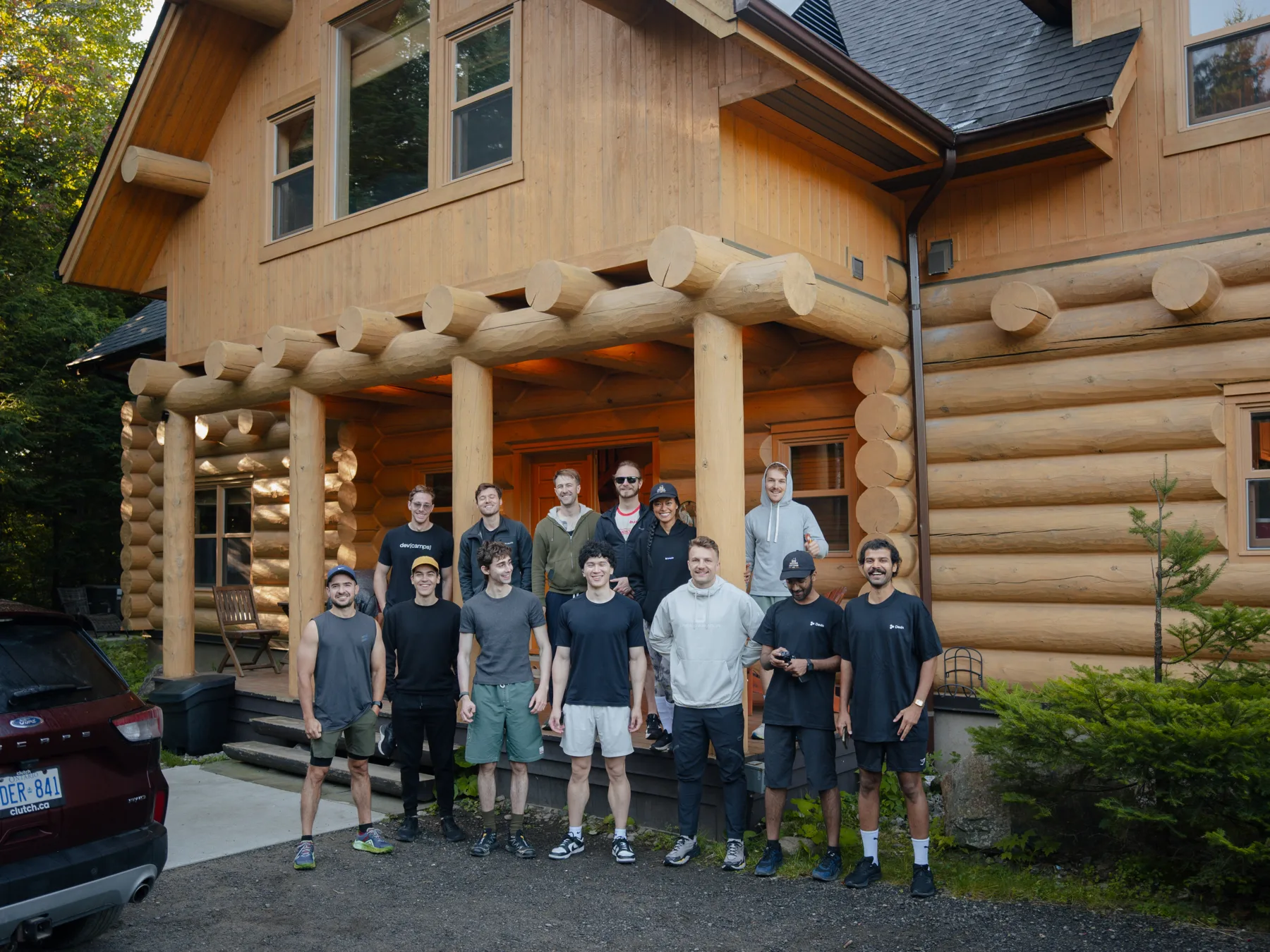
On Sunday, August 30, the builders at Hacker Cottage took turns at a podium in a log chalet on a lake in St-Sauveur, Quebec. One by one, they showed what they had built that weekend.
One agent worked through a client’s quarterly sales tax return. Another coaches audiologists live during hearing aid consultations. One builder drove a farm robot with a $30 handheld controller he reprogrammed.
Look at the full list and a pattern shows up. Most of these builders pointed AI at the unglamorous work that keeps a business running: sales tax, due diligence, background checks, failing pumps, tutoring reports, ad briefs. The rest built tools for other builders and teams.
I think that is where the opportunity is. The people who do this work know exactly what slows them down. And the payoff is easy to measure: hours saved, a deal that closes, a sanctions hit caught before the contract is signed.
Below are the demos we recorded, grouped by the kind of work they take on. Each builder’s name links to their profile and demo video. Each project or builder links to their own site.
The weekend
Hacker Cottage Weekend ran from August 28 to 31, 2026. Builders from Ottawa, Toronto, Montreal, Gatineau and Whitehorse moved into the chalet for four days. AGI Ventures Canada hosted.
Friday was arrival and a first dinner together. Saturday was heads-down building, with talks in between. On Sunday we opened the doors to guests for the demos.
Fed by Mirepoix Traiteur
Mirepoix Traiteur, a private chef and catering company in the Laurentians, planned every meal for the whole house, starting with Friday’s first dinner. We sent them our dietary restrictions ahead of time, and they took it from there.
The food was amazing, and the builders loved it. For a weekend about building, that mattered. Everyone could stay heads-down at their laptop until the food was on the table, then sit down to a meal worth stopping for.

If you are planning a team offsite or a builder retreat in the Laurentians, I recommend them. Mirepoix runs catering for corporate and wellness retreats, plus weddings and private chef dinners, from Saint-Sauveur to Mont-Tremblant. They were also one of our supporting sponsors.
Money, paperwork and risk
Three demos went after work where one wrong number has consequences.
Levante
Kirill is building Levante, an AI-native accounting firm for Canadian small businesses. He likes to build sitting next to a client. So he brought one to the cottage and spent much of the weekend learning that client’s business.
On Sunday, his agents worked through part of a quarterly HST return, using a page of the client’s own bank statement and a set of receipts. Eleven transactions reconciled on the spot. Three were exceptions, and each went a different way. The agent settled the first by itself: three charges on the statement added up to one restaurant receipt. For an Airbnb charge, it asked the client whether the trip was for business. For a large MacBook purchase, it handed the call to a CPA, with the facts, the evidence and a recommendation laid out.
Kirill says a typical firm spends 85 to 90 percent of its time on exceptions. Levante is built around them.
Flagpost AI
Nick builds Flagpost AI for mergers and acquisitions under $50 million, a range known as the lower middle market. When a small business sells, the buyer asks for every legal, customer and financial document. Those files are a mess. There are hundreds or thousands of them, with conflicting numbers and strange file names. Ask a general AI tool the same question three times and you can get three slightly different answers.
“Non-determinism kills your deals.”
Nick Stroncea, on why M&A needs the same answer every time
Flagpost turns the whole data room into one structured source of truth that people can edit and audit. Every value ties back to the file it came from, and AI agents work from that layer. That weekend he worked on extending it from financial files to legal, operational and transactional ones. He says the platform already holds more than $500 million in deal value.
Intel:legal
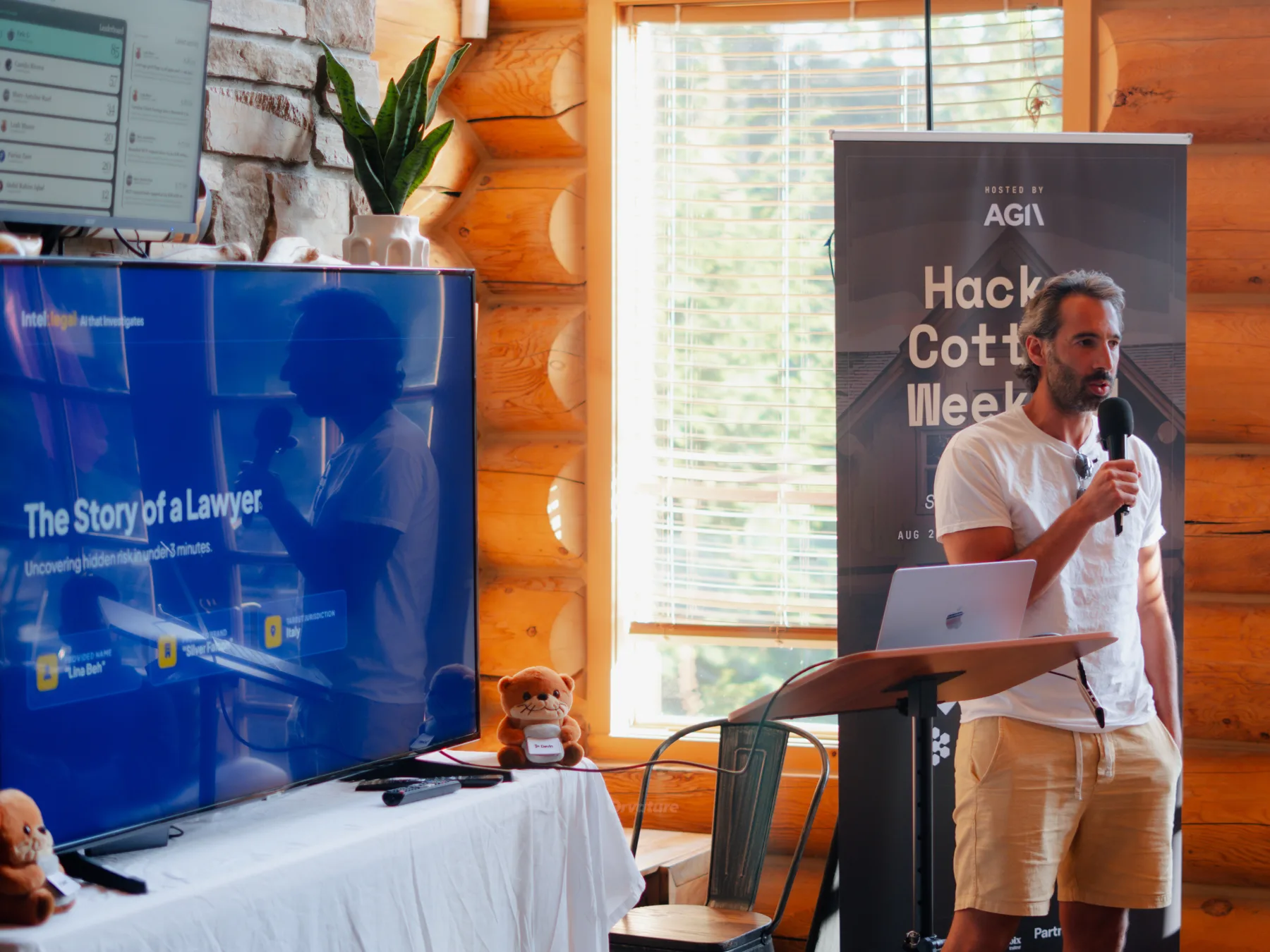
Gilad spent ten years running investigations for clients. Now he builds Intel:legal, an AI that investigates the way an intelligence professional does, for lawyers who need to vet the people their clients do business with.
His demo opened with a client who had looked up a prospective partner on Google and LinkedIn. Everything looked fine. The lawyer had a name, a brand and a country. That weekend Gilad built a loop that keeps digging into every gap the AI finds. It ran three loops. The first found the company’s legal name and business number. The second found the person’s legal name. The third found her on a US sanctions list.
It took 2 minutes and 20 seconds and cost him under 50 cents. Every step leaves an audit trail of what was searched, where, and why.
Clinics and classrooms
Three builders took on care and learning: a hearing clinic, a tutoring business and a toddler at home.
Otomatic, formerly VitaScribe
Julian Urrego co-founded VitaScribe, now called Otomatic, an AI platform for hearing care clinics in Canada and the US. It listens to the appointment and turns it into notes, tasks and billing help. Julian says that saves each audiologist about 3.5 hours a week.
Then clinic owners asked for more. An audiologist is a clinician, and also the person who sells the hearing aids. Owners wanted live guidance during that conversation. So that weekend Julian built a consultation coach. It listens alongside the audiologist, checks the conversation against the clinic’s own method, and prompts them when a question gets missed. A report follows at the end.
Conceptual Tutoring
Kerstan runs Conceptual Tutoring, a K-12 tutoring service. The student sends in what they are working on in class. The tutor uses AI to build a lesson around it. Afterward, the homework targets only the problems the student struggled with.
Before the weekend, the business ran on a chain of messages and email reminders. Kerstan built one platform for all of it. Parents see sessions and homework. Tutors see their tasks. Each session transcript gets mapped to the student’s curriculum, Ontario’s in his demo, with the tutor confirming what the student showed.
He has already sent a few parents a curriculum report written for the student’s teacher. One grade 8 student’s report shows material taught up to grade 11. Kerstan directs AI agents to build every system the business runs on.
Kidstead
Abhinav Thukral, an AI product builder in Ottawa, has worked in education technology for a decade. His daughter is two, and the daycare wait list is a year and a half long. So he built Kidstead.
Each day it suggests an activity for her age, like a rainy day picture walk, explains why, and lists what the parent needs. Afterward you log how it went with a photo or a voice note. The AI then looks across that history for threads worth following. When his daughter sorted six leaves into two groups, it proposed a new thread on leaf textures.
Farms, refineries and the front line
Three demos went to people whose workday happens far from a desk.
Tandem Robotics
Mumtahin Farabi left a software job and became a farmer on a one-acre plot. Farm work is hard on the body. Organic farms are short of workers while demand keeps growing, so a robot there fills a gap. With Tandem Robotics, he builds robots that cover a farm’s whole season of work, row by row.
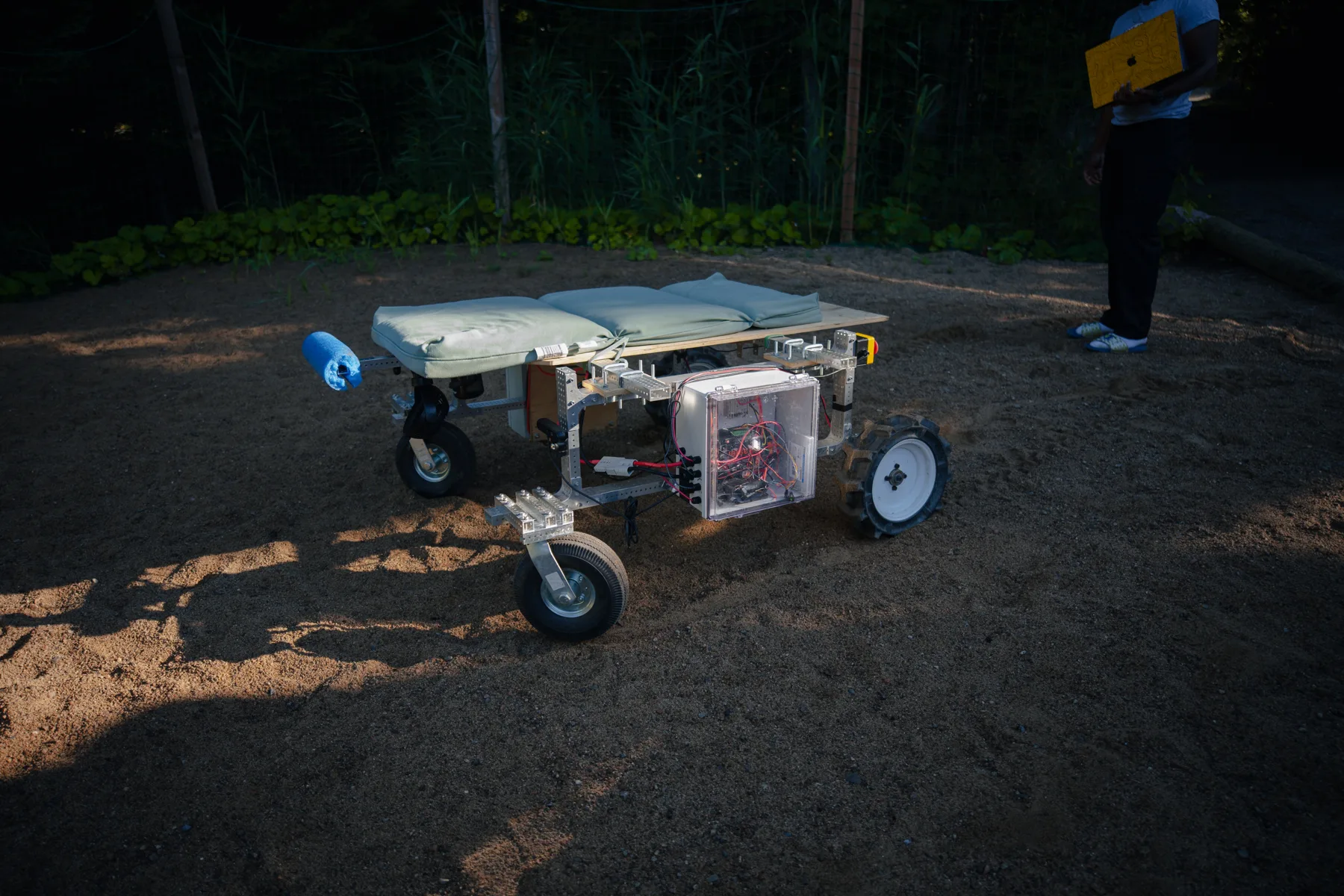
Testing robots is the hard part, so that weekend he built tools for it. A simulator moves the physical robot as you drive the virtual one. A warning sound now plays when the robot backs up, a lesson his shins taught him. He added voice commands. And because some farmers skip smartphones, he reprogrammed a $30 handheld controller to drive the robot from a pocket. It runs off a phone or any battery pack.
Pump failure diagnosis
Rahim Iqbal, an AI product builder and researcher, has built products at Amazon and Tesla. He took on a brand new project for the weekend, from a refinery customer with a recurring problem: pumps and motors fail, and a full team works to find out why.
Engineers need to see the reasoning before they trust an answer. So Rahim’s tool returns the likely root causes and draws the physical model it reasoned over, which lets a reliability engineer check the thinking. His test case was an industrial cooling fan that started shaking right after its blades were cleaned, with a balance weight missing from one blade. Next, he wants every conclusion backed by math an engineer can verify. He offered to open source it if it helps others.
Tessa by Apprendo
Camilo builds Apprendo from Whitehorse, Yukon. Its product, Tessa, is an AI chief of staff that checks in with every person on a team by phone, WhatsApp, Slack or email. His focus is what he counts as the 83 percent of the world’s workforce that is deskless: drivers, pilots, maintenance crews, people who work away from a screen.
His clients had an urgent request, so that weekend he built a private, anonymous line from employees to leadership. Workers scan a QR code, talk to the agent, and leadership sees the overall sentiment. He ran a live survey on the room. The cottage came out motivated, and a little tired of paying for tokens. The feature went to his clients that same week.
Getting found
Three builders took on marketing, the job most small businesses do on the side. A fourth started there and ended up somewhere else.
Bytown
Tomas has spent more than 14 years in growth marketing. His company, Bytown, runs ads with AI for a surgeon, a landscaper, architects and schools: people for whom marketing is a second job. A small business might spend $500 to $1,000 a month on ads and then pay an agency $2,000 to run them. Tomas calls those economics upside down.
Give Bytown a website and it learns the business, its customers, its competitors and its brand colours. It runs and tunes campaigns across Google, Meta, LinkedIn and ChatGPT in plain language. It sends reports on WhatsApp, where many of his customers already spend their day. That weekend he built a connector that lets Claude, ChatGPT or Cursor talk to Bytown directly, then asked Claude live how a school’s Google Ads were doing.
Carousel Creative
Leah has run her own ad agency, Carousel Creative, for nine years. That weekend she rebuilt her strategy process around evidence. Her system mines customer quotes from Reddit and Twitter, tags each one by pain point and objection, and builds personas and messaging angles, with Leah approving each step.
It then lines the evidence up against the client’s existing footage. That shows which angles have strong evidence and thin footage, which tells her what to shoot next. Every brief her editors receive links back to the customer quotes behind it. She walked through it with her client Cerebras, the AI chip company.
Lemonbrand
Simon helps small businesses put AI to work through Lemonbrand, mostly accounting firms. That weekend he solved his own problem: growing on social media takes more hours than he has.
His system takes an hour of footage and returns clips, captions, titles and uploads. It can also turn the same topics into videos from Abigail, a fully AI-generated creator who costs about $450 a month to run. Abigail has her own voice, wardrobe and daily routine. She wakes at 5 and hits the gym at 6. The first version of her looked too perfect, so Simon made her look less polished. He planned two layers of detail and ended up six layers deep.
In April, Simon won an AI hackathon the Alberta government ran in Ottawa, with about 1,100 people taking part. His entry was a team of AI agents that helps auditors dig through government data.
A cruise rating app
Joel runs Lemon Tree Studio, which makes mobile games, including custom games for content creators. He arrived planning an AI agent to make ads for his games. By the end of day one he had scoped it, seen its size, and pivoted to his passion project: Letterboxd for cruises.
People who cruise a lot form a big, tight community, and each voyage gets its own Facebook group. Joel’s app rates about a thousand cruises, shows what friends have sailed and rated, and opens a chat for each voyage that archives a week after it ends. Bucket list picks link out to bookings through an affiliate partner. That weekend he rebuilt the web version, and after a talk on search the day before, made it easier for search engines to find.
Tools for the people doing the work
The last six built tools for other builders and teams. They go after the same kind of grind: the plumbing behind an agent, the art pile behind a game, the follow-up after an event.
Inlay
That weekend Zach launched Inlay, the backend for AI agent products. You design the agent as a graph on a canvas, generate the code, and drop it into your app. Memory, search over your own data, scheduled runs, monitoring and billing come built in. Every agent call is metered and charged to the user’s plan.
To prove it, he built Night Shift, an app that works overnight. It finds new sales leads, researches each company and drafts the outreach email, so you wake up to a fresh list. His sample customer was an inventory tool for craft breweries.
Clover
Matt leads AI and engineering at Revoize and runs Gravitel Forge, where he helps companies with AI and engineering. His view: everyone builds software with AI now, and we talk too little about how.
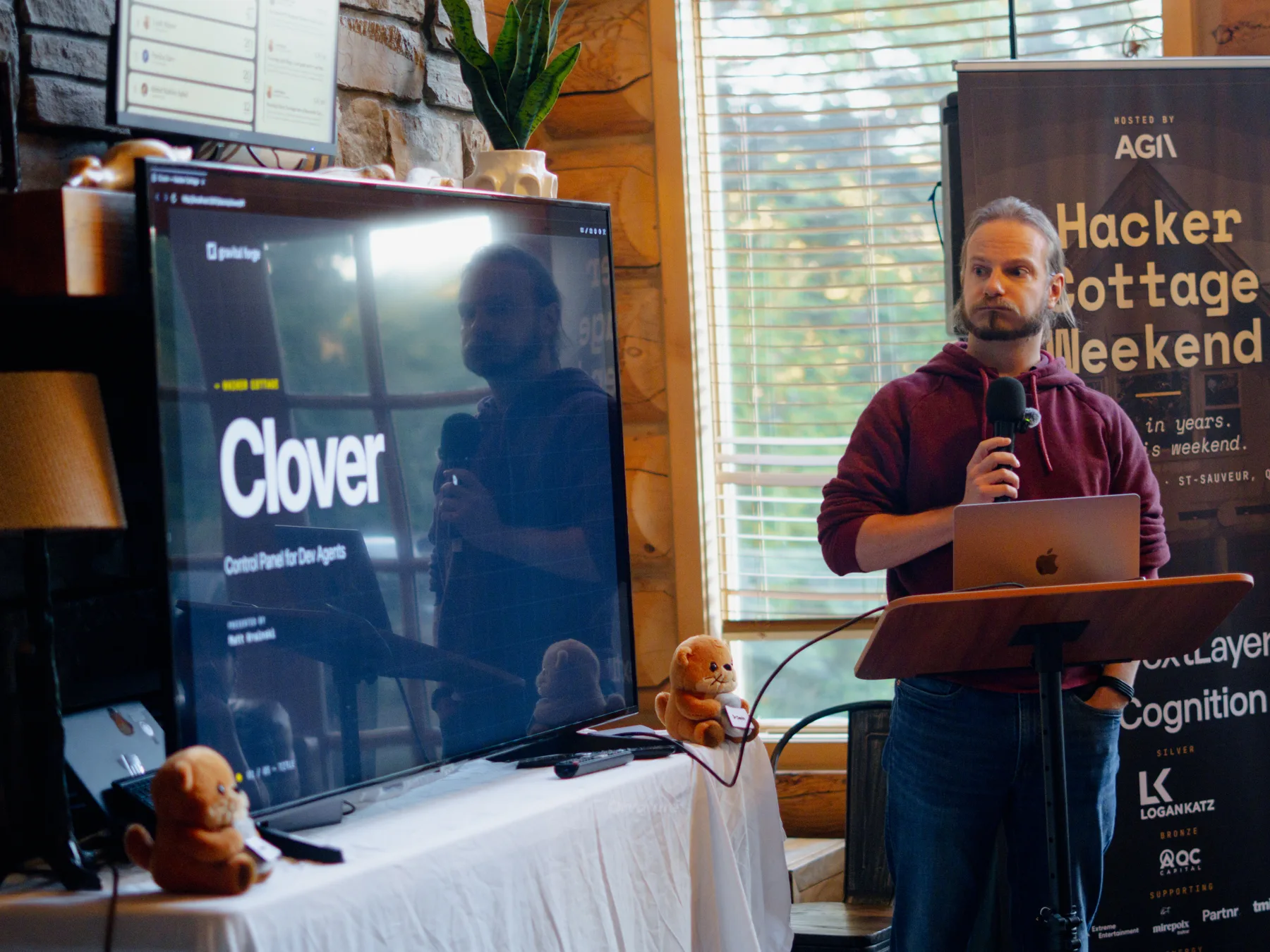
Clover is his experiment in a better way to work with coding agents. A small program on your machine relays your Claude Code sessions to a web app, where you can watch the transcripts, send commands and talk to your agents by voice. On stage, he used Clover to ask Claude to add a smiley face to the slide deck he was presenting.
GrowthPal
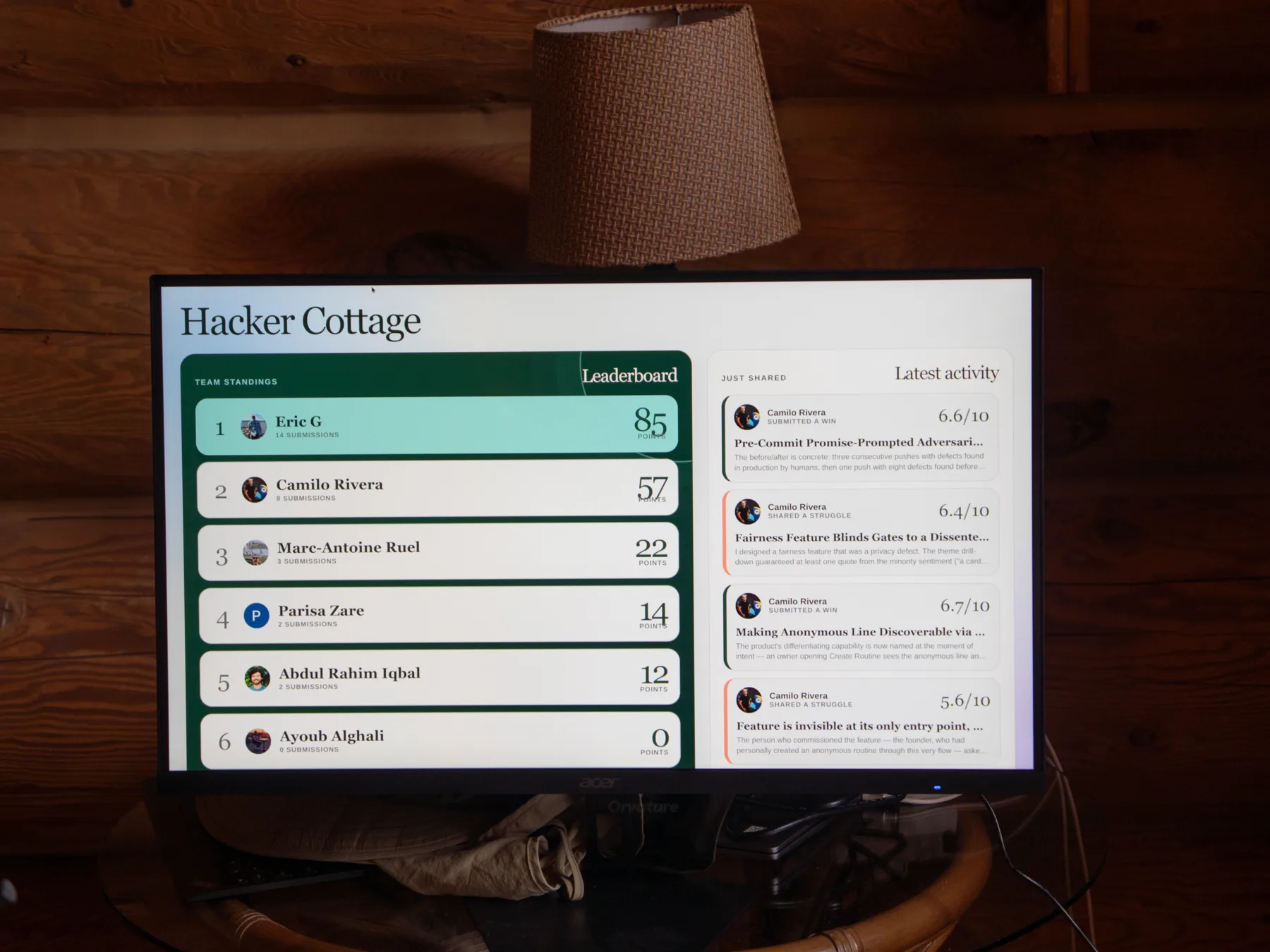
Parisa and Marc-Antoine Ruel co-founded PitchPal, an AI pitch coach that started at an AGI Ventures hackathon. Parisa helps Invest Ottawa adopt AI. Marc-Antoine spent 16 years at Google. At the cottage they built GrowthPal, which measures how a team adopts AI.
When someone does something useful with AI, like a sharp prompt or a better workflow, they tell GrowthPal to capture it. It scores the work, gives feedback and posts it to a shared leaderboard. Struggles get shared too, so the whole team learns from both. They set up a Hacker Cottage team space for the weekend. By Sunday’s demos, Eric and Camilo led the board.
Sprite AI
For game developers, the slow part is the art: hundreds or thousands of sprites and animations per game. Tommy-James left school to build Sprite AI, which uses models made for pixel art. He says it passed 30,000 signups in its first eight months.
That weekend he folded every tool into one chat. Ask for a knight with a yellow cape, then its idle animation, then its lighting. He trained the lighting model himself, on 3D models he pixelized in Blender. He chose pixel art by reading search data: plenty of demand, few strong competitors.
Spomni
Eric co-founded Bramble, which builds AI for insurance brokerages. For the weekend he built an agent for himself. His question to the room: of everyone you met here, how many will you reach out to afterward?
Spomni, which Eric says is Russian for “remember,” keeps up with the people you meet. It pulls your WhatsApp and LinkedIn messages and your calendar into a private store you own, and you ask it questions through Claude Code. It drafts. You send. Eric drew that line on purpose. Spomni is open source on GitHub.
A 3D tour of the cottage
Jack Le hosts hackathons of his own, and he wants guests to feel a house before they arrive. So he captured the cottage with Gaussian splatting, which turns ordinary photos and video into a 3D scene you can explore in a browser. He scanned the whole house in about 20 minutes.
During his demo, a friend walked the room with a camera. Before Jack finished, the audience appeared in a fresh 3D scene running on his laptop.
What the demos had in common
They brought the customer.
Kirill brought his client to the cottage and ran his demo on that client’s books. Rahim built for a refinery customer’s problem. Julian’s coach exists because clinic owners asked for it. Camilo’s feature went to his clients the same week.
The AI shows its work, and a person signs off.
A CPA makes the judgment call at Levante. Every value in Flagpost traces back to a file. Intel:legal logs every search. Rahim’s tool draws the model it reasoned over. A tutor confirms each curriculum match. Spomni drafts and you send. In these jobs, trust comes from showing the reasoning.
The builder knows the job.
Gilad ran investigations for a decade. Farabi farmed. Kerstan runs the tutoring business. Leah has run her agency for nine years. Abhinav is the parent on the daycare wait list. Each of them builds for work they have done themselves.
If you are looking for what to build with AI, I would start with the most tedious part of a job you know well.

Thank you to our sponsors
Our sponsors made the weekend possible.
Gold
Silver
- Logan Katz is a firm of chartered professional accountants.
Bronze
- AQC Capital invests in pre-seed and seed tech startups, mostly in Quebec.
- Invest Ottawa is Ottawa’s lead economic development agency.
Supporting
- Mirepoix Traiteur is a private chef and caterer in the Laurentians. They planned every meal for the house, and the food was amazing.
- Extreme Entertainment provides DJ and event entertainment.
- Partnr Media is a Canadian e-commerce marketing agency.
- TMIE Media is an Ottawa content agency that runs everything from strategy to filming to distribution.
- Tavily is a real-time search engine for AI agents.
Energy
- Ananda Elixirs makes Shroom Soda.
- POWRD makes functional sparkling drinks with yerba mate.
AGI Ventures Canada hosted the weekend. Neilda Gagné, Lila Galipeau, Thoufeek Baber, Ayoub Alghali and I organized it. Mason Landers and Abhiram Manoj Sivavilasam captured it on video and camera.
Every project in this recap
- LevanteKirill Kravinskywithlevante.com
- Flagpost AINick Stronceaflagpost.ai
- Intel:legalGilad Sarusiintel-legal.com
- OtomaticJulian Urregooto-matic.com
- Conceptual TutoringKerstan Deevyconceptualtutoring.ca
- KidsteadAbhinav Thukralabhinavthukral.info
- Tandem RoboticsMumtahin Farabitandemrobotics.dev
- Pump failure diagnosisRahim Iqbalrahimiqbal.com
- Tessa by ApprendoCamilo Riveraapprendo.co
- BytownTomas Kolafabytown.co
- Carousel CreativeLeah Mazurcarouselcreative.com
- LemonbrandSimon Bergeronlemonbrand.io
- Lemon Tree StudioJoel Diablemontreestudio.games
- InlayZachary Itzcovitchinlayai.com
- CloverMatt Krainskirevoize.com
- GrowthPalParisa Zare & Marc-Antoine Ruelgrowthpal.ca
- Sprite AITommy-James Tremblaysprite-ai.art
- SpomniEric GershteinSpomni on GitHub
- Gaussian splat tourJack Lejack-le.com